


A lingual braces consultation in Canberra gives you a clear understanding of your options through a thorough clinical assessment of your teeth, bite, and jaws. During this appointment, you can expect the following steps to help you decide what to do next.
- You will receive a complete clinical examination covering your teeth, bite, gums and jaw positions, plus a discussion of any conditions that may need attention before orthodontic treatment begins.
- Dr Jasprit Singh will carefully explain what to expect with lingual braces. She will discuss how your speech might change, how to keep your tongue comfortable early on, and exactly how the WIN lingual brace system would be tailored to your case.
- You will leave with a clear picture of your options and, once diagnostic records have been reviewed, a written treatment plan that sets out the recommended approach, itemised costs, and a realistic timeline.
What happens during a Lingual Braces Consultation
A lingual braces consultation goes beyond a standard assessment because the appliances sit entirely behind your teeth, requiring a unique clinical and practical approach.
Your visit includes a specific technical assessment to examine the inner surfaces of your teeth and see exactly how your bite will interact with hidden brackets. It also involves a detailed explanation of the WIN lingual brace system from DW Lingual Systems in Germany, showing how each custom-manufactured bracket and archwire is designed specifically for your individual anatomy.
Because lingual braces sit in the tongue space, the consultation also features an open discussion about temporary speech changes and tongue comfort during the first few weeks. This specific guidance allows Canberra professionals to carefully plan their treatment start dates around important meetings and presentations.
Prepare for Your Appointment to Get the Most Out of Your Visit
You can make the most of your first visit by reviewing our practical logistics online and gathering any relevant dental records beforehand. Taking a few simple steps will help ensure a productive and informative appointment.
- If you have a referral letter from your dentist or GP, bring it. It is not required, but it gives Dr Singh useful background.
- If you have had recent x-rays or dental scans taken elsewhere, bring those too. They may reduce the number of records that need to be taken at the consultation.
- Before the appointment, write down your questions. Patients who prepare a short list of questions, particularly about speech changes, scheduling around professional commitments, and what a written treatment plan includes, tend to leave the consultation with a clearer picture of their options.
If a consultation fee applies, current details are available on the first visit page. It is worth confirming this when you book.
Know Exactly What Happens During Your Consultation
Clinical history and concerns
Your consultation follows a clear process designed to carefully assess your oral health and match you with the right orthodontic solution. Dr Singh will guide you through this evaluation,
The consultation begins with a conversation. Dr Singh will ask about your dental history, any previous orthodontic treatment, the concerns that brought you in, and any relevant health conditions, including jaw pain, gum sensitivity, or difficulty biting.
This conversation is not a formality, it shapes the clinical assessment that follows. For lingual-specific concerns, patients commonly raise questions about speech, hygiene around brackets they cannot see directly, and how treatment may affect professional or social situations. These are all appropriate and expected questions at this stage.
Examination of your teeth, bite, and jaws
Dr Singh will examine your teeth, gums, bite alignment, and jaw joints. This includes checking gum health and the condition of existing dental work (fillings, crowns, restorations). Any conditions that may need to be addressed before orthodontic treatment begins, such as active gum disease or untreated decay, will be identified and discussed. Orthodontic treatment is generally not started until the underlying oral health is stable.
Discussion of treatment options
After the examination, Dr Singh will discuss the treatments that could work best for your case. For patients seeking a discreet option, this typically includes lingual braces (the WIN system) and, if suitable, clear ceramic braces. The aim is to have an open and honest conversation about your choices, rather than pushing a one-size-fits-all recommendation.
In the past, lingual braces were only used for simple fixes, but today’s advanced systems can handle almost any correction. Research published in the Journal of Clinical and Experimental Dentistry found that advances in lingual systems have allowed clinicians to treat the same range of cases as traditional front-facing systems, including complex cases that require jaw surgery. Dr Singh will assess whether your specific case falls within the suitable range and discuss everything with you directly.
Initial suitability discussion
Many patients find they are suitable for lingual treatment; some cases may be better managed with a different approach. Dr Singh will give you her clinical assessment at the consultation, though the full treatment plan is typically presented after diagnostic records are reviewed.
Get a Complete Clinical Picture with Diagnostic Records
A thorough orthodontic diagnosis requires more than a visual examination. Diagnostic records give your orthodontist a detailed picture of your teeth and how they relate to your jaw and facial structure. Records typically include some or all of the following:
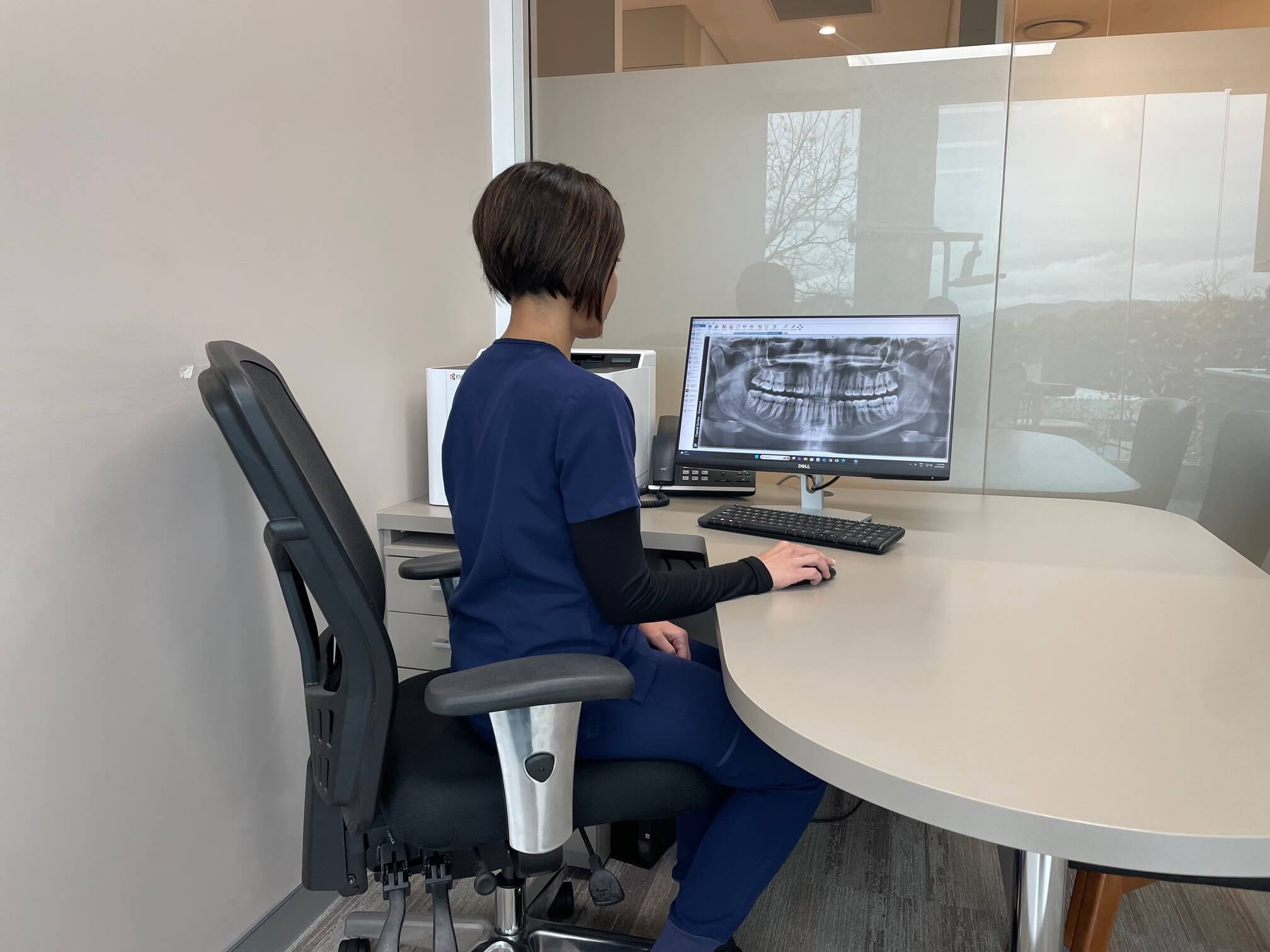
- Panoramic x-ray (OPG) – A full-mouth x-ray showing all teeth, roots, and surrounding bone. Routinely required.
- Lateral cephalogram – An x-ray of the skull in profile used to assess skeletal jaw relationships. Their necessity depends on the case.
- Intra-oral and facial photographs – A standardised photographic record of teeth and facial profile. Required for treatment planning and monitoring.
- 3D digital scan or impressions – A scan of your teeth creates a precise digital model of your bite. A PLoS One review confirmed that digital models can replace traditional plaster cast impressions in most clinical situations.
- Cone-beam CT (CBCT) – A three-dimensional radiograph, used selectively when there are impacted teeth or other complex situations requiring detailed spatial information. Not routine.
Records may be taken at the initial consultation or at a separate records appointment, depending on the practice’s workflow. Definitive pricing is generally presented after records are reviewed, so the cost conversation at the first consultation is typically a range rather than a fixed figure.
Receive a Transparent Treatment Plan and Clear Fee Structure
Once diagnostic records are reviewed, Dr Singh will prepare a written treatment plan. This typically includes:
- The recommended appliance and the clinical rationale
- Proposed treatment timeline (for most lingual brace cases at Capital Smiles, this is 18 to 24 months, with adjustment appointments 4 to 6 weeks apart)
- Itemised costs and any staged payment arrangements
- A description of the informed consent discussion: risks, alternatives, and the expected adaptation period
Costs are typically presented as a range at the initial consultation, with a confirmed figure once records have been assessed. For information on Capital Smiles’ approach to fees and treatment costs, visit the cost of braces page. If you have private health extras cover, your fund may contribute towards orthodontic treatment, and the practice can advise on health fund processing at the consultation.
Informed consent: Before treatment begins, your orthodontist should discuss the known risks of orthodontic treatment (root resorption, gum changes, temporary discomfort), realistic outcomes, and the alternatives available to you. This is an important part of your care and a requirement under Australian health regulations.
Adjust Comfortably During the Initial Speech Adaptation Period
Speech adaptation is one of the most common questions raised at a lingual consultation, and it is a fair one. Since the brackets sit exactly where your tongue naturally rests, you will need a brief adjustment period. We are completely upfront about this reality with all our patients. Your speech might sound slightly different at first, but after a week or two, any discomfort fades, minor sores heal, and your speech will very often return right back to normal.
For professionals in public-facing roles, timing the start of treatment thoughtfully. For example, around a quieter period in the diary may reduce the practical impact of those first two weeks. Your orthodontist can discuss timing considerations at the consultation.
Trust Your Care to a Highly Trained Lingual Orthodontic Specialist
Your consultation at Capital Smiles is with Dr Jasprit Nirmal Singh, a specialist orthodontist registered with AHPRA. Dr Singh holds two Masters in Orthodontics. She earned a Master of Science in Orthodontics from the Eastman Dental Institute, University College London (UCL), and a Master of Science in Lingual Orthodontics from Hannover Medical School in Germany, which she attended monthly over 24 months from October 2017 to September 2019. Dr Singh is the only orthodontist in the ANZ region with a Master of Science in Lingual Orthodontics from a prestigious university in Germany.
Her dual-Masters background means that the lingual consultation at Capital Smiles is grounded in graduate-level lingual orthodontic training, not general orthodontic practice with lingual treatment offered as one option among many. More detail on her training and background is on the meet your orthodontist page.
Frequently Asked Questions
How long does a first lingual braces consultation take?
A first specialist orthodontic consultation is typically a longer appointment than a routine dental check, with enough time for a clinical examination, treatment options discussion, and questions. A lingual consultation may run a little longer because of the additional assessment and discussion involved in evaluating behind-the-teeth treatment suitability. Capital Smiles will confirm the appointment length when you book.
Will I know at the first appointment whether lingual braces are right for me?
You will likely have an initial suitability discussion at the consultation. A definitive recommendation typically follows the review of diagnostic records, which may be taken at the same appointment or at a separate session.
Are lingual braces suitable only for mild cases?
No. Research indicates that modern lingual systems can treat the same range of cases as labial (front-facing) systems, including complex cases. Suitability depends on your specific clinical picture, which Dr Singh will assess at the consultation.
How long will my speech be affected?
Most patients find that speech returns to close-to-normal within one to two weeks, though this varies by individual. Capital Smiles’ own lingual braces page notes that “speech is very often back to normal” after this initial adaptation period.
When will I receive a written treatment plan and cost breakdown?
A written plan with itemised costs is typically provided after diagnostic records have been reviewed. At the consultation itself, your orthodontist will generally provide a cost range and a broad treatment timeline.
Ready to Book a Consultation?
If you are considering lingual braces and would like to understand whether treatment may suit your case, a consultation at Capital Smiles is the appropriate next step. Dr Singh conducts a thorough clinical assessment and provides a written treatment plan so you can make an informed decision without pressure.
For adults in Canberra considering orthodontic treatment, the adults page sets out what Capital Smiles offers for this patient group. To review the practical logistics of your first visit, including what to bring and travel options to the Deakin practice, see the first visit page.
To book a consultation or ask a question, contact Capital Smiles at:
- Phone: (02) 6111 2946
- Contact form: capitalsmiles.com.au/contact-capital-smiles/
- Address: Units 7 and 8, 26-28 Napier Close, Deakin, ACT 2600
Sources and Further Reading
- Ruiz-Maresma J, Garcia-Quintela A, Garzon-Rivas A, et al. Barriers and challenges faced by orthodontists when treating patients with lingual appliances: a web-based survey. Journal of Clinical and Experimental Dentistry. 2021;13(9):e881-e887. DOI: 10.4317/jced.58328
- Australian Health Practitioner Regulation Agency (AHPRA). Advertising guidelines: regulated health services. ahpra.gov.au
- Capital Smiles. Hidden (lingual) braces. capitalsmiles.com.au/hidden-braces/
- Capital Smiles. Meet our orthodontists. capitalsmiles.com.au/meet-our-orthodontists/