


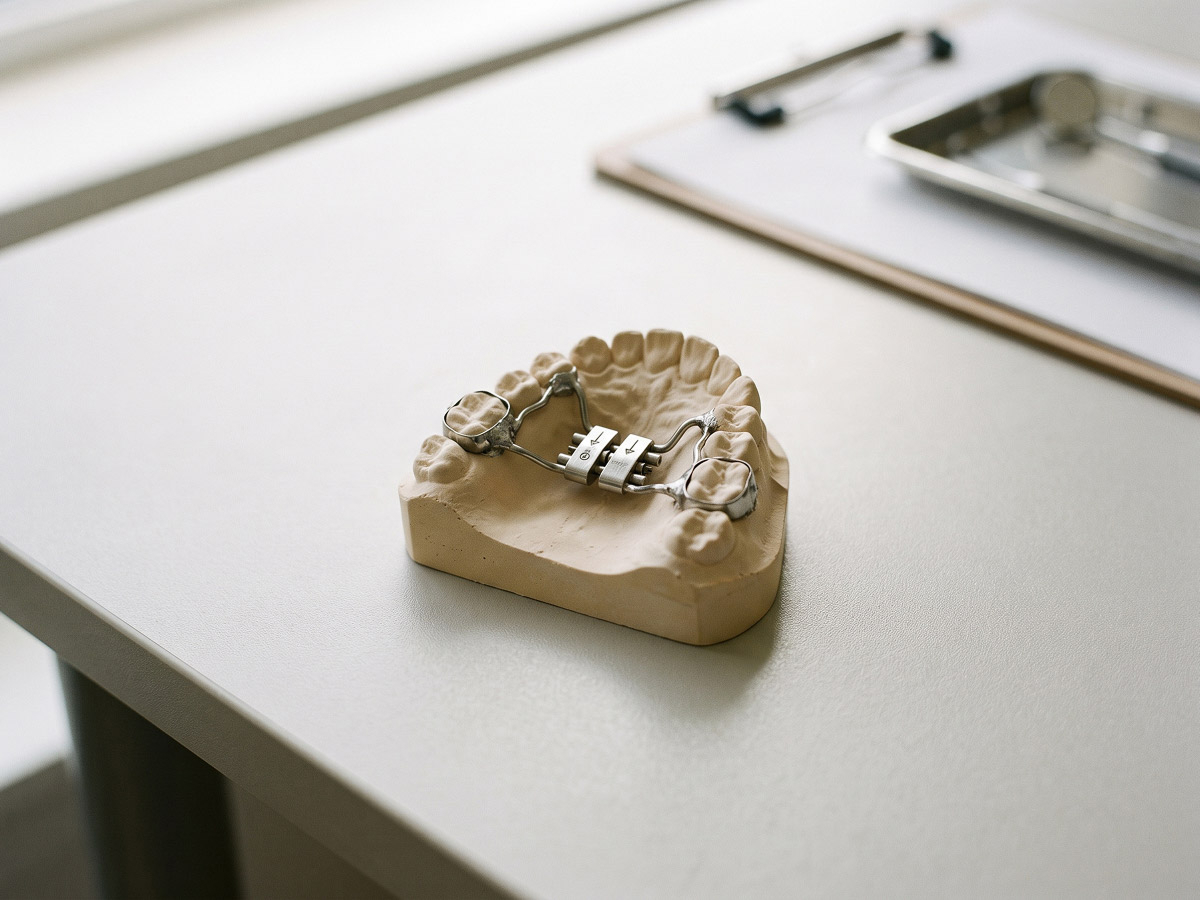
A palatal expander is an appliance designed to widen the upper jaw gently while a child is still growing. The type described here is the rapid maxillary expander, which is fixed to the teeth. Some other expansion appliances are removable.
An orthodontist decides after an examination. The decision is whether it, or another removable or fixed appliance, suits a particular child.
- Fixed expander. It is attached to the upper back teeth and often adjusted with a small key.
- Growing child. Timing matters because the joint in the upper jaw is often not yet fused.
- Removable or fixed. The two types differ in who handles wear and cleaning.
- Orthodontist decides. Which appliance suits a child is decided after an examination.
- Every plan differs. Growth, the bite and wear all vary, so this guide explains the process rather than showing results.
What Is a Palatal Expander and What Does It Do?
The palatal expander most families hear about is a fixed appliance designed to widen the upper arch. The practice’s own name for it is a rapid maxillary expander (RME). A related fixed expander on the upper back teeth is called a Quadhelix.
The practice’s appliance page describes an RME as fixed to the upper side and back teeth, and sometimes to the upper jaw bone. It says the appliance is used to create space for unerupted teeth and to correct cross-bites. The Quadhelix is described as usually used for some space creation and for cross-bites.
A Scottish NHS patient leaflet from NHS Lothian explains the design in plain words. The appliance is cemented to the teeth at the sides of the mouth.
A screw joins the two sides across the roof of the mouth, and a special key opens it to widen the arch. Patient leaflets from the United Kingdom are used here for general background. The practice’s own instructions always take priority.
An expander is often used for bite problems such as a crossbite. The common bite problems page explains what these are.
Why Is Expansion Linked to a Growing Child?
Expansion is usually considered while a child is still growing. The upper jaw is made of two halves that meet along a joint in the roof of the mouth. In a growing child that joint is often not yet fused, which may allow a gentle widening.
A paper in the Dental Press Journal of Orthodontics describes rapid expansion as opening this joint. It notes that fusion of the joint is a common reason expansion fails in late adolescents and young adults. That varies between people, so there is no single age that suits every child.
A Cochrane review looked at trials in children. A fixed appliance (the quad-helix) and removable expansion plates were both more beneficial than no treatment. This applied to correcting a posterior crossbite in children aged 7 to 11.
That is a finding about groups of children in trials. Only the treating orthodontist can say what is suitable for your own child.
How Is the Expander Turned?
Many rapid expanders are adjusted with a small key, and the orthodontist sets how often and for how long. Those details vary between children and between appliances, so this page gives no numbers.
The Scottish NHS Lothian leaflet leaves the number of turns and days blank for the clinic to complete. That suggests the schedule is set for each patient by the treating clinic. If turning the key causes severe pain, the NHS Lothian leaflet advises stopping and contacting the clinic. The practice’s own instructions always come first.
Afterwards the expander often stays in place for a period while the teeth and arch settle. The orthodontist decides how long, and may advise further treatment afterwards.
What Can the First Days Feel Like?
Some children notice mild to moderate discomfort in the first days of turning. A gap may also appear between the two upper front teeth. Each child is different.
The NHS Lothian leaflet says a patient may feel a little mild to moderate discomfort the first few times the key is turned. It says this should disappear after a few days.
It also says a gap between the upper front teeth is normal during turning. That gap often closes later, and the orthodontist manages this as treatment continues.
Some children take a short time to adjust to a new appliance in the mouth. If eating or speaking feels difficult, mention it at the next visit or call the practice.
How Do Removable Plates and Fixed Appliances Compare?
A removable appliance usually comes out for meals and cleaning, while a fixed appliance stays attached to the teeth. The practical difference is who carries the responsibility.
With a removable plate, how consistently it is worn may affect how well it works. An archived 2009 functional appliance leaflet from the UK-based British Orthodontic Society covers this point. It says the daily wear hours will be explained.
It adds that following these instructions is important for the treatment to work.
The same leaflet says the brace is likely to feel sore for about 3 to 5 days after each adjustment. The orthodontist explains what to expect.
With a fixed appliance, the orthodontist controls the wear. The child’s job is careful cleaning and avoiding foods that may damage it.
Neither type suits every child, and the orthodontist chooses between them after an examination. The practice’s children’s page says a range of fixed or removable appliances can be used for early treatment.
The right choice depends on the orthodontic problem. Our guide to early orthodontic treatment covers how that decision is made.
What Are the Twin-Block, Herbst and Facemask?
These three appliances are used for different bite problems, and the practice describes each on its appliance page. The wear times below are the practice’s own usual figures and may differ for your child.
| Appliance | Fixed or removable | Used for | Usual wear |
| Upper removable plate | Removable | Expanding the upper arch and moving some teeth | 6 to 12 months |
| Twin-Block | Removable | Reducing protruding upper front teeth | 9 to 12 months |
| Herbst appliance | Fixed | Reducing protruding upper front teeth | 9 to 12 months |
| Facemask | Worn outside the mouth, attached to an expander | An upper jaw that sits behind the lower jaw | 14 hours a day for 12 months |
The Twin-Block has removable upper and lower parts. Our page says it is used to guide and reduce the protrusiveness of the upper front teeth. It can be removed for eating, cleaning and active sport, and is usually worn for 9 to 12 months.
The Herbst appliance is fixed. Our page says it cannot be removed for eating or cleaning and is usually worn for 9 to 12 months. The same page describes a further fixed appliance that attaches to braces already in the mouth.
The facemask is worn in front of the face and is usually attached to an expander. Our page says it is used when the upper jaw sits behind the lower jaw, a situation often called an underbite. It is usually worn 14 hours a day for 12 months.
The upper removable plate, also on the practice’s page, is usually worn for 6 to 12 months. All of these figures are guides, and the orthodontist confirms the plan for your child.
What Is Everyday Life With an Appliance Like?
Daily life with an appliance may change a few habits, mainly around food, cleaning and sport. The orthodontist gives instructions for the specific appliance, and those take priority over general advice.
Eating
A removable appliance usually comes out for meals unless the orthodontist says otherwise. A London children’s dentistry leaflet from King’s College Hospital advises avoiding sticky, hard or chewy foods. A fixed expander stays in, so ask the orthodontist which foods to avoid while it is fitted.
Cleaning
The King’s College Hospital leaflet advises brushing a removable appliance daily and keeping it in a protective box when it is out of the mouth. The orthodontist confirms the routine for your child. Fixed appliances need careful brushing around the metalwork. Our guide to looking after braces covers the routine.
School and Speech
Speech can sound a little different at first with a removable appliance. The King’s College Hospital leaflet suggests reading or counting aloud at home. It also notes a child may produce more saliva than normal.
If a child plays a wind instrument, mention it to the orthodontist.
Sport
The practice’s page says its removable plate and Twin-Block can be taken out for active sport. The British Orthodontic Society and King’s College Hospital leaflets both suggest a gumshield for contact sport.
A fixed appliance cannot be taken out, so ask the orthodontist what protection suits. You can read about mouthguards in our article on ceramic braces for teenagers.
If Something Comes Loose
A loose band or expander should be reported to the practice rather than left until the next routine visit. The US-based American Association of Orthodontists lists a loose band or appliance as an issue to report. It gives an expander as an example.
The British Orthodontic Society leaflet says the same about a broken removable appliance. Ask the practice what to do in the meantime.
Why Does This Guide Not Show Before and After Photos?
One child’s result does not show what another child may experience. Growth, the type of bite and how well an appliance is worn all vary, so this page explains the process rather than showing photos. Questions about your own child are answered at an examination.
The advertising guidelines from Ahpra ask for care with before and after images. That is because they may create unreasonable expectations of a successful outcome.
How Can Families Take the Next Step?
Questions about your own child’s plan are best put to the treating orthodontist, because an appliance is only suggested after an examination. Dr Jasprit Singh, a Canberra-based specialist orthodontist at Capital Smiles in Deakin ACT, can explain the options and the reasons behind them. Questions about fees can also be raised at the consultation.
To read more about the appliances the practice uses, see the other appliances page. To arrange a visit or ask a question, get in touch through the contact page.