



Early orthodontic treatment begins while a child still has a mix of baby and adult teeth, often between the ages of seven and ten. It is used for specific developing problems rather than as a routine step for every child. For many children, an early assessment simply leads to monitoring as they grow rather than treatment straight away.
- Timing: Treatment takes place while baby and adult teeth are both present
- Phase 1: A shorter first course of treatment carried out before full braces
- Two-phase: A first course, a resting period, then a second course once the adult teeth are through
- Monitoring: Many children assessed early are watched and reviewed rather than treated
- The decision: An assessment helps determine whether to treat now, monitor or wait
What Does Early Orthodontic Treatment Actually Mean
Early orthodontic treatment is treatment that begins before all the baby teeth have gone. Australian guidance puts that window at roughly eight to ten years old, once the front adult teeth have come through.
The timing matters because a child is still growing. A developing jaw can respond to guidance in ways it cannot once growth has finished, so early treatment is often less about straightening teeth and more about guiding how the jaws and teeth develop.
This is also why the term can be confusing. Parents may hear “early treatment” and picture braces on a seven-year-old. In practice, it usually means something smaller and more targeted at a particular developing issue.
What Is Phase 1 or Interceptive Treatment
Phase 1 and interceptive treatment describe the same general idea from slightly different angles. Interceptive treatment refers to stepping in to address a developing problem, while Phase 1 refers to the first stage of treatment when another stage may follow later.
We use the Phase 1 label here at Capital Smiles Orthodontics too. As our children’s orthodontics page puts it, this is “treatment that is carried out prior to full braces”, and it can use “a range of appliances, whether fixed or removable” depending on what the individual child needs.
A Phase 1 course is usually shorter and narrower than a full round of braces. It targets one thing, such as making room for an adult tooth that has nowhere to go, or correcting a bite that is causing the jaw to shift. You can read more about the sorts of devices involved on our other appliances page.
Starting early does not automatically mean your child will have two rounds of treatment. Some early treatment is a single, self-contained course with no further treatment needed afterwards.
How Does Two-Phase Treatment Work
Two-phase treatment is a plan split across two stages, at two different times, matched to how a child grows. It has three parts, and the middle one surprises many parents.
Phase 1 begins while a child still has a mix of baby and adult teeth. The focus is usually on guiding jaw growth or addressing a particular developing problem rather than achieving the final position of every tooth.
A resting period follows. This gives the jaw and teeth time to continue developing while the remaining adult teeth come through. The child is reviewed during this time rather than actively treated, and the length of the resting period depends on their growth.
Phase 2 starts once most or all of the adult teeth are in. This is the stage that looks like conventional braces, and it is where teeth are settled into their final positions.
Two-phase treatment therefore involves a longer period of care with an orthodontist, but it is not two full rounds of braces back to back. It can also mean a higher overall cost than a single course of treatment during the teenage years, which is one of the factors considered before it is recommended.
Which Problems Can Early Treatment Help With
Early treatment is considered for particular developing problems rather than general crookedness. Australian and international guidance broadly identifies the following issues as reasons an orthodontist may consider acting earlier.
| Issue | Why acting early is sometimes considered |
| Crossbite | An upper tooth biting inside the lower one, which can make the jaw shift when closing |
| Protruding upper front teeth | Teeth that sit well forward are more exposed if your child has a knock or fall |
| Reverse overjet (Underbite) | Jaw relationships respond more readily to guidance while a child is still growing |
| Significant crowding | Space can be created or held open for adult teeth that are still to arrive |
| Impacted or missing teeth | Imaging can show a tooth stuck in the bone before it causes trouble nearby |
| Persistent thumb or dummy habits | Where the habit is actively shaping how teeth and jaws are developing |
The aims listed on our children’s orthodontics page follow the same pattern. Where early treatment is appropriate, it may be used to help with the following.
- Creating or maintaining space for unerupted adult teeth
- Reducing the risk of teeth becoming impacted
- Improving the relationship between the upper and lower jaws
- Reducing the risk of damage to protruding upper front teeth
Capital Smiles Orthodontics is deliberately more cautious about two other possible benefits. Early treatment may reduce the need for full braces later or shorten the time spent in braces, but these are possibilities rather than outcomes that can be promised for every child.
The strength of the evidence also varies depending on the problem. Crossbite and protruding front teeth have been studied in controlled trials. For crowding, impaction and sucking habits, decisions about early treatment rely more heavily on clinical assessment of how the teeth and jaws are developing.
Does Early Treatment Lead to a Better Result?
The answer depends on the problem being treated. Research gives us useful information for some conditions, but early treatment does not automatically mean a better final orthodontic result.
For children with noticeably protruding upper front teeth, a Cochrane review compared treating early in two phases against waiting and treating once in adolescence. Fewer children in the early group went on to injure those front teeth: around 19 per cent, compared with 30 per cent of those treated later.
The same review found no other advantage from two-phase treatment over a single phase in adolescence for this particular problem. For protruding front teeth, the main reason for treating earlier may therefore be reducing the risk of injury rather than achieving a better final result.
Posterior crossbite has been studied differently. A separate Cochrane review of children aged seven to eleven found that widening the upper arch with a fixed or removable expansion appliance worked better than observation alone. However, that research compared treatment with no treatment rather than early treatment with later treatment, so it does not establish one ideal age for treatment.
There is no single answer to whether early treatment is worthwhile. It depends on the problem, how your child’s teeth and jaws are developing, and what an orthodontic assessment shows.
Why Many Children Simply Need Watching
Many children who come in for an early assessment do not start treatment that day, and that is a normal, planned outcome rather than a delay.
The American Association of Orthodontists notes that two-phase treatment is not required for every child and that many orthodontic problems can be managed with a single course later on. If nothing needs treating yet, an orthodontist can monitor growth and tooth eruption and recommend treatment only if and when it becomes beneficial.
Growth can also change what an orthodontist sees over time. Orthodontics Australia notes that an underbite in a very young child may sometimes settle as baby teeth are replaced. In that situation, treating too early could mean treating something that may have resolved naturally.
Monitoring is a decision with a reason behind it. Your child is reviewed as they grow, so that if something does need attention, it is picked up at the right moment rather than missed.
What Happens at an Assessment
An early orthodontic assessment is designed to answer a simple question. Does anything need attention, and if so, when? The first visit is about understanding how your child’s teeth and jaws are developing rather than automatically starting treatment.
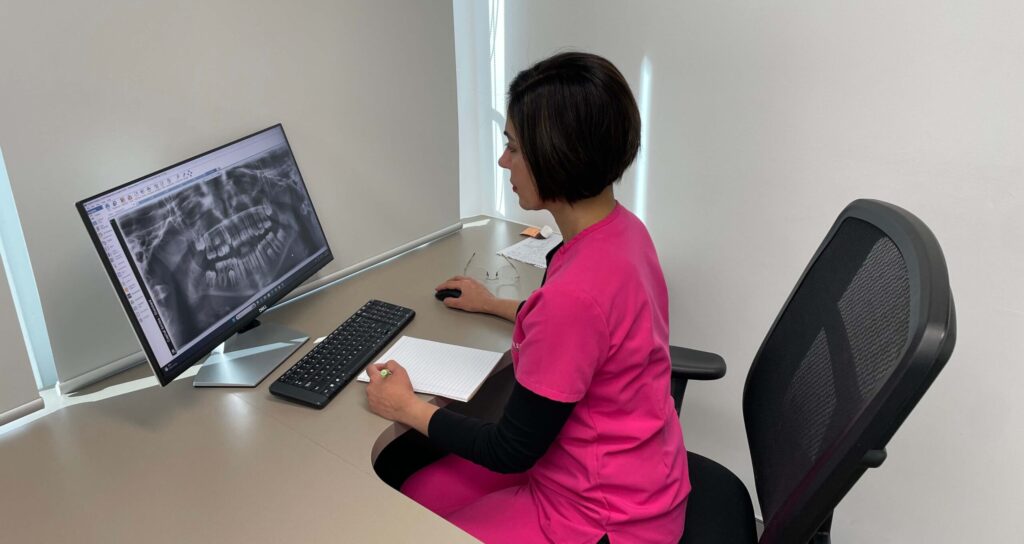
An orthodontist assesses the baby and adult teeth along with the face, lips, jaws and bite. Crowding, deep bites, crossbites, open bites, reverse overjet (underbites) and overbites can all be identified at this stage. X-rays or scans may also be taken when needed to see teeth that are still developing in the bone.
There are four possible outcomes, and each can be an appropriate result of an assessment.
- Nothing needs doing, and nothing needs watching for now
- Something is developing, so it is monitored and reviewed as your child grows
- Something needs treating, but not yet, because for some problems a single course as a teenager may reach the same result
- Something is better addressed now, with a clear explanation of why waiting could make it harder
Whichever it is, you should leave knowing which one applies to your child and why. If you would like to understand the terminology before you come in, our page on common bite problems explains the terms in plain language.
Cost is also reasonable to ask about before treatment begins. Orthodontic treatment sits outside Medicare, and the Child Dental Benefits Schedule specifically excludes it. Families with a higher level of private health extras cover may be able to claim part of the cost, although many funds apply a 12-month waiting period. You can find more information, including payment plans, on our cost of braces page.
Booking an Assessment in Canberra
If your child is between seven and ten, an orthodontic assessment can help determine whether anything needs attention now or simply needs to be monitored. There is no single right age for every child’s first appointment, and booking an assessment does not commit you to treatment.
An early assessment also does not automatically mean years of appliances. For many children, the outcome is simply to review their development later. Even when two-phase treatment is recommended, the period between Phase 1 and Phase 2 is a resting period rather than continuous active treatment.
You do not need a referral from your dentist to book with us. Dr Jasprit Singh is a specialist orthodontist who sees children at our practice in Deakin, ACT. She holds two master’s degrees in orthodontics, an MSc in Orthodontics from UCL Eastman and a Master of Science in Lingual Orthodontics from Hannover Medical School.
You can read more about how we assess and care for younger patients on our children’s orthodontics page, or find out about options for older children on our adolescents page. When you are ready, you can get in touch with our team to arrange a first visit.
Sources and Further Reading
- Orthodontics Australia: Benefits of Early Treatment
- Orthodontics Australia: Everything You Need to Know About Orthodontic Referrals
- American Association of Orthodontists: 6 Facts About Two-Phase Treatment
- American Association of Orthodontists: What Are the Benefits of Early Orthodontic Treatment?
- American Association of Orthodontists: The Milestone Visit, Why Age 7
- American Association of Orthodontists: Child Orthodontics
- Cochrane: Orthodontic Treatment for Prominent Upper Front Teeth in Children
- Cochrane: Orthodontic Treatment for Posterior Crossbites
- Orthodontics Australia: Does Health Insurance Cover Orthodontics in Australia?
- Australian Dental Association (teeth.org.au): Child Dental Benefits Schedule
- Capital Smiles: Children’s Orthodontist in Canberra
- Capital Smiles: Common Bite Problems
- Capital Smiles: Your First Orthodontist Appointment
- Capital Smiles: Cost of Braces
- Capital Smiles: Other Appliances
- Capital Smiles: Meet Our Orthodontists