


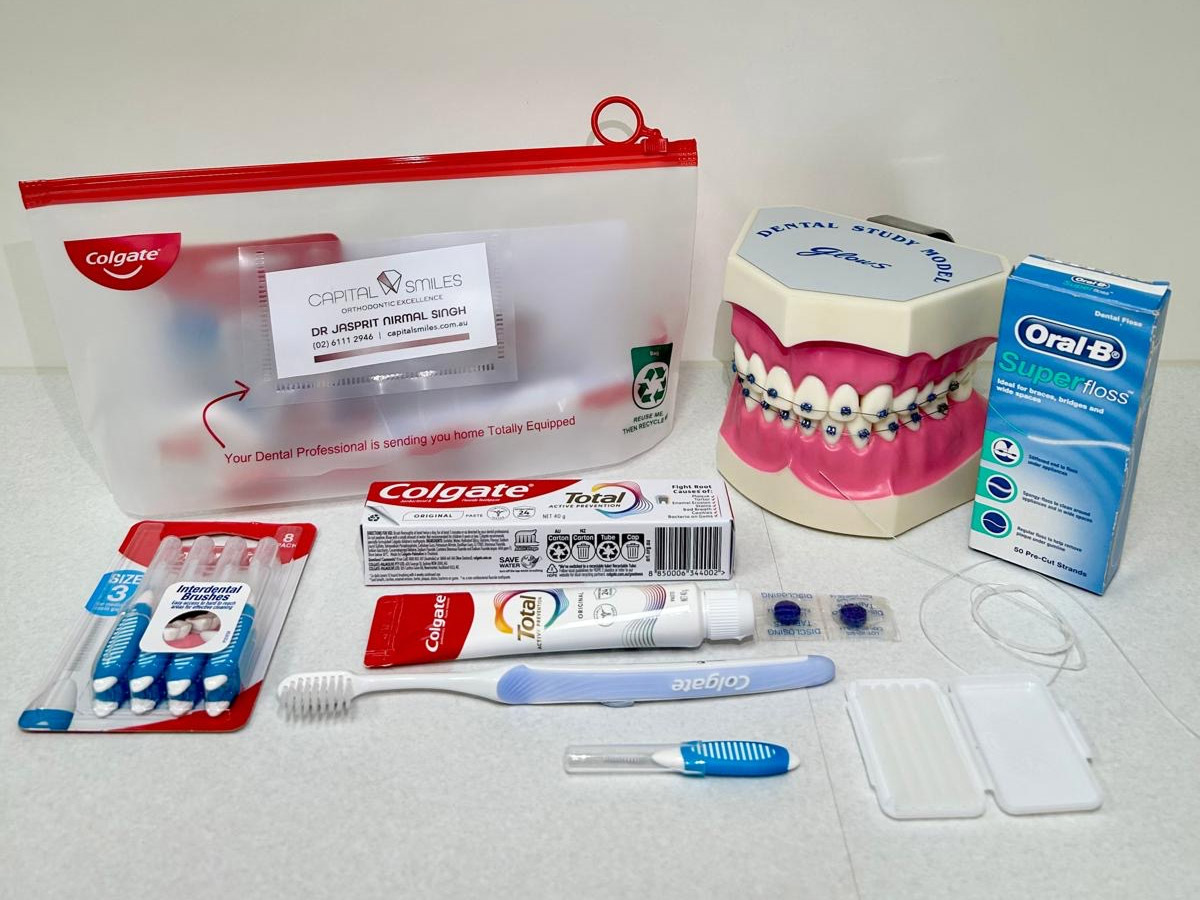
Looking after braces comes down to brushing after every meal, cleaning carefully around the brackets and wires every day, and avoiding hard, sticky and sugary foods. The rest is knowing what to do when a bracket or wire comes loose.
- Brush after every meal, angling the brush above and below each bracket
- Use an interdental brush or floss threader daily to clean areas a toothbrush can miss
- Avoid hard, chewy, sticky and sugary foods that can damage braces, and limit sugary foods and drinks that increase the risk of tooth decay
- A loose bracket or poking wire is common, rarely an emergency, but needs prompt attention
- Mild discomfort after an adjustment usually settles within about a week
What Should I Do If a Bracket, Wire or Band Comes Loose
Most broken brackets, loose wires and similar appliance problems need advice from your orthodontist rather than hospital care. Serious injuries or symptoms are different and need urgent medical or dental attention.
Seek urgent medical or dental care, not just a call to us, if your child has
- Heavy or uncontrolled bleeding from the mouth or face
- Trouble breathing or swallowing
- A suspected broken or dislocated jaw, or major facial trauma
- A permanent tooth knocked out or badly displaced
Everything else on this list is an urgent orthodontic problem. We need to know about it, but it is rarely life-threatening. The table below sets out what to do at home while you wait to be seen.
| Problem | What is happening | What to do at home meanwhile | When to call |
| Loose or broken bracket | Come away from the tooth, may still be on the wire | If on the wire, gently slide it toward the tooth’s middle and cover with wax | As soon as reasonably possible |
| Poking or loose wire | The end has worked loose and is rubbing the cheek | Push it flat with a clean cotton swab or cover with wax | If it cannot be made comfortable, or recurs |
| Loose band or appliance (including an expander) | Come partly or fully away | Do not wiggle or pull it. If off completely, keep it and bring it to your appointment | Contact us immediately, particularly if an expander or other active appliance is involved |
| Lost separator | A spacer has come out early, before the band appointment | Nothing needs doing | Let us know so we can check whether it needs replacing before your appointment |
The first three rows follow guidance from the American Association of Orthodontists. Lost separator guidance is practice-specific rather than externally sourced. Ask us how many days before your appointment a lost separator is worth a call. General guidance does not settle it.
A small kit at home, and ideally a second in your child’s school bag, makes these moments less stressful. Pack a small mirror, orthodontic wax, a travel toothbrush, floss threaders and clean tweezers. If a small piece of wire has already broken free, clean tweezers may help remove it, but never pull or force anything that resists.
We already give you a care kit at the start of treatment. Adding a few travel-sized essentials can make it easier to manage minor problems away from home.
The table above says which problems need a call today and which can wait for your next visit. A loose band or appliance, including an expander, is the one to ring about straight away. Either way, telling us sooner rather than later keeps the treatment plan on track.
What Does a Good Daily Cleaning Routine Look Like With Braces
A good routine means brushing after meals and cleaning carefully around the brackets, underneath the wire and between the teeth. Being consistent matters more than being flawless. Once your child has braces on, twice-daily brushing on its own is no longer quite enough.
Brushing technique. A flat, straight-across stroke misses more than you might expect. Orthodontics Australia recommends starting at the gum line, at a 45-degree angle to the gums. From there, angle the brush downward over each bracket and upward underneath it, so both sides get cleaned. A soft-headed manual or electric toothbrush both work.
Frequency. Plaque catches more easily around brackets and wire. Orthodontics Australia recommends brushing after every meal rather than the usual twice a day. For a school-aged child, that means packing a travel toothbrush in your child’s school bag, not just leaving one at home.
Getting between the teeth. A toothbrush cannot reach between teeth around an archwire, so your child needs a second tool as well. If flossing tape is a struggle, Orthodontics Australia suggests floss threaders or small interdental brushes instead. It also cautions against pressing too hard. Interdental brushes have the stronger evidence. One study of 15 to 30 year olds ran for 30 days. Plaque fell by roughly 40% and gum inflammation by roughly 43%, beating floss in the same study. Floss threaders or superfloss are a useful backup for tighter contacts.
Water flossers, honestly assessed. A water flosser can also be useful for some patients. Clinical trials have found that both water flossers and other interdental cleaning methods can reduce plaque, with no clear overall advantage for one method. A separate trial found Super Floss and a water flosser equally effective overall. If a water flosser makes your child’s daily routine easier to maintain, ask us how best to use it around their braces.
Fluoride. The right fluoride toothpaste depends on your child’s decay risk, their age, and whether your water is fluoridated. The Australian Dental Association recommends using fluoride toothpaste according to the product directions or a dental practitioner’s advice, taking age, access to fluoridated water and individual tooth decay risk into account. Ask us whether a particular toothpaste strength, mouthrinse or in-chair fluoride application suits your child’s treatment plan.
The care kit we provide at the start of treatment supports this routine. Our living with braces page has more on what it includes.
What Are White Spot Marks and How Can They Be Prevented
White spot marks are patches of demineralised enamel that form around brackets when plaque sits against the tooth for too long. They often do not become visible until the braces come off, and once they form they are often permanent. That is why this is worth attention during treatment rather than at the end of it. The good news is that the things that prevent them are ordinary and well evidenced, and they are set out below.
Why it happens. Brackets and wires create additional areas where plaque can collect and make some tooth surfaces harder to clean. When plaque remains against the enamel, particularly with frequent exposure to sugary foods and drinks, minerals can be lost from the tooth surface and white spot lesions can develop.
How common it is. Research shows that white spot lesions are a recognised complication of fixed orthodontic treatment, although reported rates vary considerably between studies. Differences in oral hygiene, treatment duration, existing enamel changes and the way lesions are measured all affect the numbers reported.
What tends to help, in the order the evidence supports it:
- Fluoride varnish, applied regularly by a dental professional. This was the single most effective measure in one review. It was associated with new marks in 11.7% of patients versus 29.7% without it. A separate review found a similar pattern, roughly two-thirds the risk with regular use. It is worth asking us whether we offer this.
- High-fluoride toothpaste, used daily. The same review found daily use significantly reduces new marks.
- CPP-ACP products may help. These are a repairing ingredient found in some toothpastes and creams. They can reduce these marks and help rebuild enamel, and they work best alongside fluoride. Ask us about them rather than assuming they suit your child.
- Consistent daily hygiene underpins everything above. Good habits are ideally started before treatment begins. Fluoride and CPP-ACP add to this; they are not a substitute for it.
Good hygiene through treatment may significantly lower the risk of these marks. It cannot guarantee they never appear. The evidence supports a meaningfully lower risk, not a certainty. We flag this as something good hygiene helps prevent. It is worth keeping in mind through treatment, not only at the end.
Which Foods Should Be Avoided With Braces, and Why
Foods matter for three separate reasons. They can break the hardware, distort the wire, or feed the plaque that causes the marks above. Knowing the reason behind each makes the list easier for you and your child to stick to than a plain ban.
Foods that can break a bracket or wire. Brackets are bonded to hold under normal chewing, not a direct hard bite. Hard foods can loosen brackets or damage wires, which may mean an extra repair appointment and can interrupt treatment progress. Repairing it also adds time to treatment. Whole apples, carrots, nuts, pretzels and corn on the cob sit in this group. Slicing an apple into bite-sized pieces keeps it on the menu safely. Corn kernels can also be cut from the cob before eating.
Foods that distort or dislodge the wire. Lollies, liquorice, caramel and chewing gum work differently. They pull and tug at the wire rather than snapping a bracket. Sugar-free gum in a soft strip is generally fine. Bubble gum is worth avoiding. It usually contains sugar and is stickier, so more likely to lodge in the wire.
Foods and drinks that feed decalcification. This group does not damage the appliance. It damages the tooth underneath it. Sticky or high-sugar foods trapped around brackets set up the conditions for decay. Frequent sugary drinks, including soft drink, cordial and fruit juice, can also increase the risk of tooth decay and enamel demineralisation. This is the mechanism behind the white spot marks above, so it carries the longest-lasting consequence of the three.
What stays on the menu. A food list can read as more restrictive than it is. Several other foods stay on the menu throughout treatment. These include soft carbohydrates such as bread and mashed potato, plus soups and dairy foods. Fruit and vegetables cooked soft or cut small are fine too. In the first week, while the mouth adjusts, softer foods take the pressure off tender teeth. Try yoghurt, boiled vegetables, soft meats, stewed fruit and thin soups.
Our living with braces page has our own quick-reference food guidance for you, alongside the care kit and wax information.
How Much Discomfort Is Normal After Fitting or an Adjustment
Some soreness after braces are fitted and after adjustment appointments is common. It is often most noticeable during the first one to three days and generally improves over the following days, although some tenderness can last for up to a week.
The first one to two weeks. We already flag this discomfort in our own guidance. Tenderness while biting or chewing is common at first, and soft foods can make the first few days easier. Orthodontic wax can also help if a bracket is rubbing against the inside of the mouth.
Adjustment appointments. The amount and duration of discomfort vary from person to person. Research on fixed braces shows that discomfort typically rises during the first day after orthodontic force is applied and then gradually settles. It is usually temporary rather than a sign that something is wrong.
What tends to help. Try soft foods such as yoghurt, smoothies or scrambled eggs. A warm salt water rinse and orthodontic wax over anything rubbing helps as well. Over-the-counter pain relief can help too, taken as directed on the packaging or by a pharmacist. Packaging directions or a pharmacist’s advice are the source to follow for dosing, not this article.
If soreness is severe, does not ease after a week, or is not explained by a recent fitting or adjustment, call us rather than waiting it out.
Do Sport and Mouthguards Need Anything Different With Braces
Children can continue participating in sport while wearing braces, but a suitable mouthguard is important for activities where there is a risk of contact, collision or a blow to the mouth. Because teeth move during orthodontic treatment, the fit of the mouthguard also needs to be checked regularly.
The most suitable mouthguard depends on your child’s sport, age, stage of dental development and orthodontic appliance. Some mouthguards are designed specifically to accommodate braces and ongoing tooth movement. Ask us which type is appropriate rather than assuming a standard mouthguard will continue to fit throughout treatment.
Keep the mouthguard clean according to the manufacturer’s or dental practitioner’s instructions, store it in a ventilated container and keep it away from excessive heat. If it becomes distorted, uncomfortable or no longer fits properly, have it checked rather than continuing to use it.
If your younger child still has adult teeth coming through, the guard may need checking more often. This is a conversation to have with us rather than a general rule.
What Happens Once the Braces Come Off
Once treatment finishes, a retainer becomes the next part of the routine, worn to hold your child’s teeth in their new position. That is a large enough topic to deserve its own article, so this one stops at the appliance itself.
When Should I Contact Capital Smiles Orthodontics
Most day-to-day questions are exactly what a call to us or a routine appointment is for. That covers a loose bracket, a food question, or ordinary post-adjustment soreness. If something feels wrong and this guide has not settled it, get in touch with our team. If your child is not yet a patient and you are weighing up next steps, our first visit page sets out what an initial appointment involves.
Sources and Further Reading
- Orthodontics Australia: How to Care for Braces
- Orthodontics Australia: Foods You Can and Can’t Eat With Braces
- Orthodontics Australia: Hobbies and Braces
- Orthodontics Australia: Mouthguard for Braces
- American Association of Orthodontists: What Is an Orthodontic Emergency and How Do You Handle Them?
- American Association of Orthodontists: Mouthguards, Protecting Your Smile
- PMC: Orthodontic Post-Adjustment Pain Control (peer-reviewed)
- PMC: Prevention of White Spot Lesions With Fluoride Varnish During Orthodontic Treatment With Fixed Appliances, Systematic Review
- PMC: Prevention of White Spot Lesions Induced by Fixed Orthodontic Therapy, Literature Review
- PMC: Effectiveness of Water Jet Flossing and Interdental Flossing for Oral Hygiene in Orthodontic Patients, Randomised Clinical Trial
- PMC: Comparative Evaluation of Cleaning Efficacy of Interdental Brush and Interdental Floss in Orthodontic Patients
- PMC: Effectiveness of Super Floss and Water Flosser in Plaque Removal for Orthodontic Patients, Randomised Controlled Trial
- Australian Dental Association: Policy Statement 2.2.1, Fluoride Use
- Capital Smiles: Living With Braces
- Capital Smiles: First Visit
- Capital Smiles: Contact Capital Smiles
- Capital Smiles: Clear Ceramic Braces
- Orthodontics Australia: A Teen’s Guide to Orthodontics