


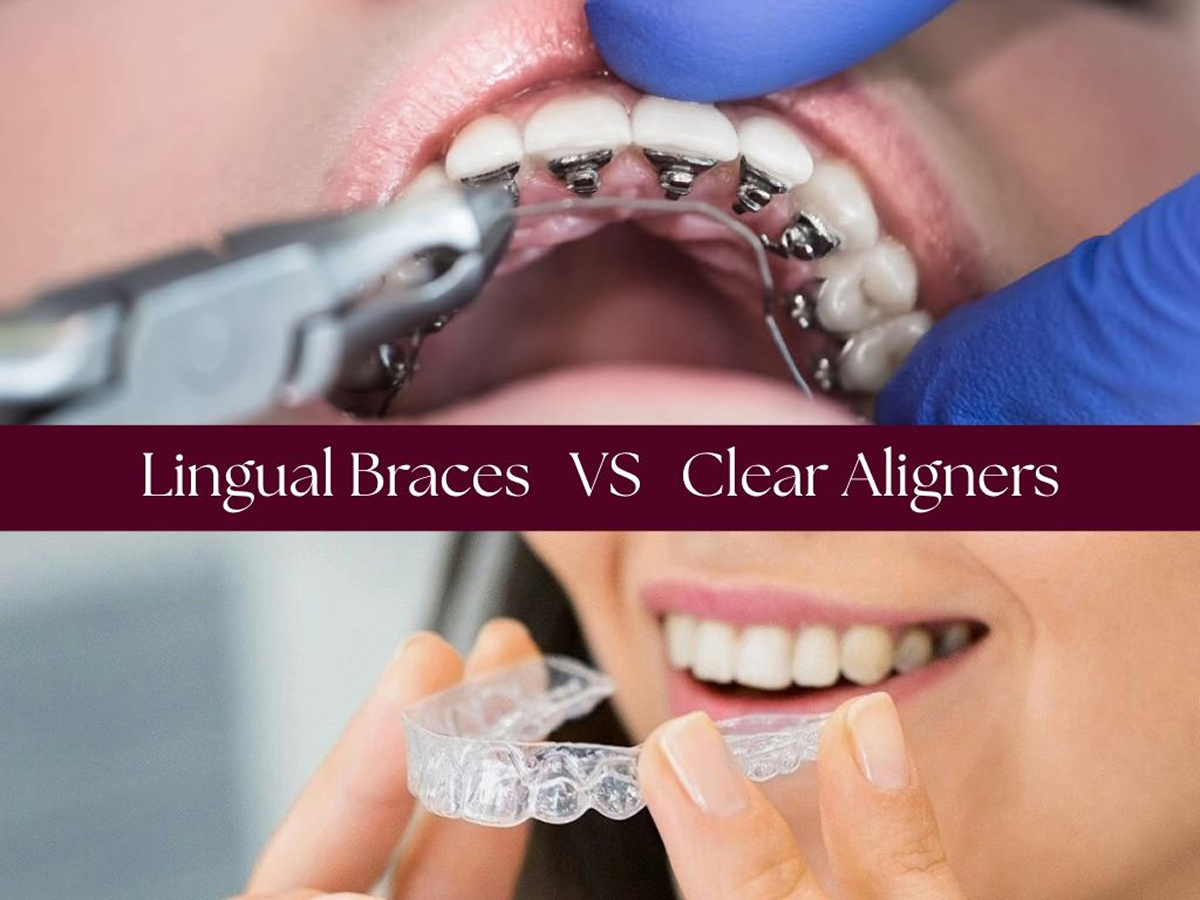
Lingual braces and clear aligners are two effective ways to straighten teeth invisibly, and we find they fit into a daily routine very differently. The right choice depends on your lifestyle, case complexity, and whether you prefer a fixed or removable option.
- Lingual braces are bracket-and-wire appliances bonded to the back of your teeth, so they are not visible from the front and apply gentle force continuously without requiring you to remember to wear them.
- Clear aligners are removable plastic trays that you must remember to wear for at least 22 hours a day, changing them every one to two weeks.
A 2025 systematic review and meta-analysis in the European Journal of Orthodontics found that both achieve orthodontic treatment goals effectively, and that the right choice depends on your specific needs and how readily you can commit to daily wear.
What Lingual Braces Are, in Plain English
Lingual braces are orthodontic brackets bonded to the back of your teeth, making them virtually invisible as they are completely hidden from the front. They are a fixed appliance that works continuously around the clock without requiring any daily effort from you. We use the fully customised WIN system from Germany at Capital Smiles, which supports precise tooth movement on a case-by-case basis. Treatment generally takes 18 to 24 months, with adjustments required every four to six weeks. This is a specialised approach that requires postgraduate lingual training, which not all orthodontists hold.
What Clear Aligners Are, in Plain English
Clear aligners are custom-moulded, removable transparent plastic trays that gradually shift your teeth over time. They are discreet at a conversational distance but are not entirely invisible when viewed up close. Because they are removable, you take them out to eat, drink anything but water, and clean your teeth. The final result relies on consistent personal discipline, as the trays need to be worn for 20 to 22 hours per day.
Compare How Each Invisible Option Fits Into Your Daily Routine
The table below compares eight common considerations. It uses soft qualifiers throughout because individual experience varies, and the right appliance depends on your specific case and circumstances.
| Factor | Lingual Braces | Clear Aligners |
| Visibility | Bonded behind the teeth; virtually invisible to others | Transparent plastic trays; difficult to detect at distance, transparent up close |
| Appliance type | Fixed; removed by your orthodontist at end of treatment | Removable; you put them in and take them out |
| Daily wear discipline | Appliance works continuously; no daily wear decision required | Manufacturer protocol around 20 to 22 hours per day; outcome depends on consistent wear |
| Typical treatment time | Often 18 to 24 months (Capital Smiles); depends on case complexity | Duration varies with case and compliance; may range from shorter mild cases to 24 months or longer |
| Complex case suitability | Suits a wider range of cases including more comprehensive/complex treatment | More commonly used for mild to moderate alignment issues; tooth movement prediction may vary |
| Speech adaptation | Adaptation period often 1 to 2 weeks; some patients longer | Adaptation period reported; typically similar 7 to 14 days |
| Early discomfort | Initial soreness and possible tongue irritation; typically resolves with adaptation | Soreness reported with each new tray; some research reports less pain on days 3 to 4 compared with fixed appliances |
| Maintenance | Clean around fixed brackets and wires using interdental brushes or a water flosser | Remove trays to eat and clean; clean trays separately |
Treatment Time and How Case Complexity Affects It
Treatment duration depends primarily on the complexity of your orthodontic needs rather than simply the appliance you choose. An orthodontist will assess your specific case, but here is a general guide to how timeframes compare.
- The American Association of Orthodontists notes that standard braces treatment generally ranges from 12 to 24 months and depending on your specific bite and alignment.
- At Capital Smiles, most lingual brace cases range from 12 to 24 months, with adjustment appointments every 4 to 6 weeks.
For more complex cases involving tooth extractions or significant bite correction, the 2023 systematic review by Jaber and colleagues found that fixed appliances like lingual braces may offer more control and faster results for complex cases that involve tooth extractions or significant bite correction. Clear aligner duration varies considerably with the case and with the consistency of wear during treatment.
An orthodontist can assess your specific case and provide a realistic estimate for either approach.
Match Your Treatment Choice to Your Daily Lifestyle
A meaningful practical difference between lingual braces and clear aligners is how each relates to daily patient behaviour.
Clear aligners are removable, which means the appliance only moves your teeth when it is in your mouth. Manufacturer protocols specify around 20 to 22 hours of wear per day and sequential tray changes on a set schedule. For some patients, the flexibility to remove the tray for meals and social occasions is welcome. For others, the discipline of extra compliance required represents a real consideration.
Lingual braces are bonded to the teeth. Between appointments, the appliance works without any action on your part. There is no daily decision about wear time. Some patients find this consistency preferable; others prefer the flexibility of a removable tray. The right fit depends on your lifestyle and how you respond to each kind of responsibility.
Compare How Each Option Affects Your Speech During the First Week
Both lingual braces and clear aligners can affect speech in the first weeks of treatment, because both introduce something new into the space where the tongue moves during speech.
A 2023 systematic review in the European Journal of Orthodontics found that lingual braces typically cause more noticeable initial speech change than aligners, because the brackets occupy the tongue-side surface of the teeth where consonants like /s/, /t/, and /d/ are formed. Clear aligners also affect speech, though generally to a lesser degree. Most patients in that review adapted within 7 to 14 days, and a smaller group required a longer period of up to 30 to 60 days.
Capital Smiles’ own patient guidance describes a similar pattern for lingual treatment. Speech may feel different for a week or two and is typically back to normal as the tongue adapts. Individual experience varies, and patients who speak regularly in public-facing settings may wish to factor the adaptation period into their timing.
Learn How Initial Discomfort Compares Between Aligners and Lingual Braces
Some soreness in the first days of treatment is normal with both appliance types, because teeth respond to the forces being applied.
A 2023 systematic review and meta-analysis in BMC Oral Health found that patients with clear aligners reported less pain than those with fixed appliances on the third and fourth day after starting treatment. At other time points during the study, the difference in pain levels between the two groups was not statistically significant. With lingual braces specifically, some patients also experience temporary tongue irritation from the bracket profile in the first week, which typically reduces as the soft tissue adapts. Orthodontic wax may be used for comfort during this period.
Most patients find that the initial days are the most noticeable, and that the experience eases considerably after the first week.
Visibility and Discretion in Professional Settings
For Canberra professionals whose work involves presentations, committee appearances, client meetings, or regular media contact, the visibility of any orthodontic appliance is a practical consideration.
- Lingual braces are bonded to the inside surfaces of the teeth. From the front, nothing is visible during speech or smiling. Orthodontics Australia describes lingual braces as practically invisible for this reason.
- Clear aligners are made from transparent medical-grade plastic and are much harder to detect than metal braces. Orthodontics Australia notes that while nearly invisible, they are not entirely undetectable at close range. In most professional settings, this distinction is unlikely to be apparent to colleagues. In very close interactions, the tray may be visible.
Both options offer much more discretion than traditional metal braces. The degree of discretion that matters for a particular patient depends on their role, the nature of their professional interactions, and their personal preference.
Maintenance and Oral Hygiene During Treatment
Oral hygiene routines differ between the two appliances.
Clear aligners are removed for eating and brushing, so tooth-cleaning technique does not change significantly during treatment. The trays themselves need to be rinsed or cleaned regularly to prevent discolouration and odour.
With lingual braces, as with any fixed appliance, patients learn to clean around the brackets and wires. Interdental brushes, a water flosser, or a combination of both are commonly used alongside regular brushing.
A 2023 systematic review of systematic reviews published in Healthcare (Basel) concluded that the overall impact on periodontal health is broadly comparable between clear aligners and fixed appliances across the course of treatment, although aligners may offer better short-term control of plaque accumulation, particularly in the first year. With attention to cleaning technique, fixed appliance patients can maintain good periodontal health throughout treatment.
Working with Your Orthodontist on the Right Choice
The most important step in choosing between lingual braces and clear aligners is a specialist assessment. The evidence consistently shows that both can be effective, and the decision turns on case-specific factors including the complexity and type of tooth movement needed, as well as your lifestyle, preferences, and professional circumstances.
Our practice is led by Dr Jasprit Nirmal Singh, who holds two Masters degrees in Orthodontics. She earned a Master of Science in Orthodontics from the Eastman Dental Institute, University College London, and a Master of Science in Lingual Orthodontics from Hannover Medical School, Germany. She is the only orthodontist in the ANZ region with this academic qualification. Lingual orthodontics are our most advanced option, and Dr Singh has extensive clinical experience with the WIN lingual brace system across a range of case types.
During the initial consultation, she can assess your specific case and explain which approach may be appropriate for your circumstances.
Frequently Asked Questions
What is the difference between lingual braces and clear aligners?
Lingual braces are fixed brackets bonded to the inside surfaces of the teeth. They work continuously and are not visible from the front. Clear aligners are removable transparent plastic trays that cover the teeth. Both can address orthodontic alignment concerns, but they differ in how they work, what the daily experience is like, and which case types they are typically used for. Your orthodontist can advise which option may suit your circumstances.
Which suits complex orthodontic cases, lingual braces or clear aligners?
Both can be effective. A 2025 meta-analysis in the European Journal of Orthodontics found that case complexity and patient compliance should guide appliance selection. For more complex cases involving tooth extractions, a 2023 systematic review reported that fixed appliances may offer additional control in achieving precise tooth movement. An orthodontic assessment is the only way to determine which approach may be appropriate for your specific case.
How long do lingual braces take compared with clear aligners?
Duration for both approaches depends on the complexity of the case and, for aligners, on consistent daily wear. The American Association of Orthodontists notes that braces treatment generally ranges from 12 to 24 months. At Capital Smiles, most lingual brace cases range from 12 to 24 months. Aligner duration varies with the case and the wear protocol set by the treating orthodontist. Your orthodontist can provide a realistic estimate after assessing your case.
Will lingual braces or clear aligners affect my speech?
Both can affect speech in the early weeks of treatment. A 2023 systematic review in the European Journal of Orthodontics found that lingual braces tend to cause more noticeable initial speech change than aligners, though most patients adapted within 7 to 14 days. Capital Smiles’ patient guidance describes a similar pattern. Speech typically returns to normal within a week or two as the tongue adapts to the new appliance.
Are lingual braces more painful than clear aligners?
Initial soreness is common with both. A 2023 meta-analysis in BMC Oral Health found that aligner patients reported less pain than fixed appliance patients on the third and fourth day after starting treatment, with no significant difference at other time points. With lingual braces, some patients also experience temporary tongue irritation in the first week, which generally eases as the soft tissue adapts.
How visible are clear aligners compared with lingual braces?
Lingual braces are bonded to the inside surfaces of the teeth and are generally not visible to others during normal interaction. Clear aligners are transparent plastic and are much harder to detect than metal braces; however, Orthodontics Australia notes they are not entirely invisible when viewed up close. For most professional settings, both options offer substantial discretion compared with traditional metal braces.
Does Capital Smiles offer clear aligners?
Capital Smiles specialises in fixed orthodontic treatment, including lingual (hidden) braces, ceramic braces, and metal braces. The practice does not offer clear aligner systems. If you are considering both options, Dr Singh can discuss the clinical considerations relevant to your specific case at a consultation, including appropriate referral where that is in your interest.
Capital Smiles and Lingual Orthodontics
Capital Smiles is a specialist orthodontic practice in Deakin, Canberra. Lingual orthodontics is the practice’s most advanced orthodontic braces treatment.
Dr Jasprit Nirmal Singh holds two Masters degrees in Orthodontics. She earned a Master of Science in Orthodontics from the Eastman Dental Institute, University College London, and a Master of Science in Lingual Orthodontics from Hannover Medical School, Germany. She is the only orthodontist in the ANZ region with this academic qualification. The WIN lingual brace system she uses is fully customised to each patient’s dental anatomy and is manufactured in Germany specifically for each case.
If you want a clinical assessment of which approach may suit your case, a consultation at Capital Smiles is the best next step. Dr Singh will assess your teeth and bite, explain what treatment may involve for your specific circumstances, and provide realistic timeframes and cost information. There is no obligation to proceed at consultation.
For more information about lingual orthodontics, visit the hidden braces page or the adults orthodontics page.
Book a consultation at Capital Smiles in Deakin, or call (02) 6111 2946.
Sources and Further Reading
- Alhafi ZM, Hajeer MY, Alam MK, Jaber ST. Comparative effectiveness of clear aligners and fixed appliances in orthodontic treatment. European Journal of Orthodontics. 2025;47(6):cjaf091. https://academic.oup.com/ejo/article-abstract/47/6/cjaf091/8299876
- Baeshen HA, El-Bialy T, Alshehri A, Awadh W, Thomas J, Dhillon H, Patil S. Speech changes and adaptation with orthodontic appliances. European Journal of Orthodontics. 2023;45(1):11-20. PMID 35522548. https://academic.oup.com/ejo/article/45/1/11/6581942
- Li Q, Du Y, Yang K. Pain comparison between clear aligners and fixed appliances: a systematic review and meta-analysis. BMC Oral Health. 2023. PMID 38001455. https://pubmed.ncbi.nlm.nih.gov/38001455/
- Jaber ST, Hajeer MY, Sultan K. Effectiveness of clear aligners and fixed appliances in extraction-based orthodontic treatment. Cureus. 2023. PMCID PMC10148732. https://pmc.ncbi.nlm.nih.gov/articles/PMC10148732/
- Di Spirito F, D’Ambrosio F, Cannatà D, D’Antò V, Giordano F, Martina S. Periodontal health during orthodontic treatment: a systematic review of systematic reviews. Healthcare (Basel). 2023. PMCID PMC10178428. https://pmc.ncbi.nlm.nih.gov/articles/PMC10178428/
- Al-Nadawi M, Kravitz ND, Hansa I, Makki L, Ferguson DJ, Vaid NR. Invisalign wear compliance and its effect on treatment outcome. The Angle Orthodontist. 2020. PMCID PMC8028485. https://pmc.ncbi.nlm.nih.gov/articles/PMC8028485/
- American Association of Orthodontists. Braces. https://aaoinfo.org/treatments/braces/ (Accessed 2026)
- Orthodontics Australia. Lingual Braces. https://orthodonticsaustralia.org.au/lingual-braces/
- Orthodontics Australia. All About Clear Aligners. https://orthodonticsaustralia.org.au/all-about-clear-aligners/