



Many Canberra professionals are choosing invisible braces because their roles often involve committee appearances and media briefings where visible dental hardware could be a distraction. They want a treatment option that supports professional discretion without compromising on clinical results.
- We offer lingual braces as a hidden option, working behind the teeth where they are generally not visible to colleagues or the public during normal interactions.
- Ceramic braces offer a discreet, tooth-coloured alternative on the front of the teeth for cases where lingual placement is not suitable.
- Peer-reviewed research indicates that these discreet options draw less visual attention than traditional metal braces, which can support professional confidence in high-visibility settings.
Canberra’s Professional Workforce and Why Appliance Visibility Matters
Canberra has an unusually high concentration of professional and managerial roles. According to the 2021 Australian Bureau of Statistics Census, professionals make up 31.4 percent of the ACT workforce and managers a further 17.9 percent. This means nearly half of the working population is in roles that regularly involve public-facing communication, media contact, or high-stakes presentations.
In a city where professional presentation carries real weight, adults considering orthodontic treatment are mindful of how they appear in their working environment. When a polished appearance is essential for work, the question is simple. What are the most discreet options and how visible are they in practice?
What Research Says About Appliance Visibility in Professional Contexts
The case for discreet orthodontic treatment in professional settings is grounded in peer-reviewed research. Studies indicate that the type of appliance you wear has a measurable effect on social perception.
- A 2011 study in the European Journal of Orthodontics found that adults with no visible appliance were rated as having higher intellectual ability and attractiveness compared to those with visible front-facing brackets.
- A 2020 eye-tracking study in The Angle Orthodontist showed that hidden lingual appliances do not change how people perceive a face. Meanwhile, traditional front facing brackets naturally draw the eye for much longer.
- A 2022 study in BioMed Research International confirmed that an adult’s social and professional position heavily influences their appliance preferences, with those in highly visible roles prioritising aesthetic discretion.
While individual experience varies, the evidence indicates that lingual placement reduces how much visual attention is drawn to the teeth in study conditions.
The Two Discreet Options at Capital Smiles
We offer two options for patients seeking discreet orthodontic treatment. Suitability for each depends on case complexity, clinical assessment, and your individual priorities.
Lingual (Hidden) Braces
Lingual (hidden) braces are fixed braces placed on the inner (tongue-facing) surfaces of the teeth. Capital Smiles describes them as “the only truly invisible way to move teeth precisely and with good control.” Because the brackets and archwires sit behind the teeth, they are not visible in normal face-to-face interactions or in photographs taken at a standard distance.
We use the WIN lingual brace system from DW Lingual Systems, Germany. Each bracket and archwire is custom-manufactured per patient. Treatment time for most cases ranges from 18 to 24 months, with adjustment appointments typically 4 to 6 weeks apart.
There is an adaptation period. Lingual braces sit in the tongue space, which means some temporary discomfort and speech change in the first week of treatment. After a week or two, any discomfort disappears, minor sores heal, and speech very often returns to normal. If you regularly present to committees or the media, you should discuss timing your start date to allow for this adjustment.
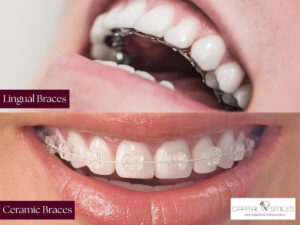
Ceramic (Clear) Braces
Ceramic (clear) braces use tooth-coloured brackets placed on the front surfaces of the teeth. They blend with the natural tooth colour and are less conspicuous than metal brackets, but they are not completely inconspicuous. At close range or in photographs, they remain visible.
Ceramic braces may suit patients who do not require the complete concealment of lingual placement, who have case characteristics that make lingual treatment less suitable, or for whom the cost difference between the two options is a material consideration. Dr Jasprit Singh will discuss which option is clinically appropriate for a specific case at consultation.
A Note on Treatment Scope
Our practice is a specialist orthodontic clinic. We do not offer aligner-based treatment such as clear aligner systems. Our focus is fixed orthodontic treatment, including both lingual and ceramic options, carried out by a specialist orthodontist.
Dr Jasprit Nirmal Singh holds two Masters degrees in Orthodontics. She earned a Master of Science in Orthodontics from the Eastman Dental Institute, University College London. She also earned a Master of Science in Lingual Orthodontics from Hannover Medical School, Germany making her the only orthodontist in the ANZ region with this academic qualification. Further detail on Dr Singh’s training and specialist registration is available on the Meet Our Orthodontists page.
What to Consider Before Booking a Consultation
Before booking your visit, it helps to understand what a consultation involves and what practical factors you need to consider.
Treatment timeline. Most lingual brace cases at Capital Smiles range from 18 to 24 months. If you have a significant professional milestone approaching, you may want to factor the early treatment stages into your timing.
Speech and comfort. Lingual braces involve a one to two-week adaptation period. Plan for this if you have scheduled presentations or hearings immediately following your fitting. Ceramic braces do not carry this same speech adjustment risk.
Cost transparency. We provide a price range before and during your consultation. Exact costs are provided after your records are reviewed and a treatment plan has been finalised.
Appointment scheduling. Consultations can be arranged by contacting us @ 02 6111 2946 or filling out an enquiry form. The Deakin practice is easily accessible from central Canberra and offers convenient and free roadside or private parking. Book a consultation.
Suitability. Not every case is suited for every appliance. The initial consultation is where Dr Singh determines whether lingual braces, ceramic braces, or another approach fits your specific alignment needs.
Take the Next Step to Discuss Your Options
For Canberra professionals who have been researching discreet orthodontic treatment, the consultation is where generalised information becomes specific to your case. The adults orthodontic services page provides a starting point for understanding how adult treatment at Capital Smiles is managed.
If you are ready to discuss whether lingual or ceramic braces could be a good fit for your situation, you can book a consultation with Dr Singh. The consultation reviews your case, treatment options, and likely timeline.
Sources and Further Reading
- ABS Census 2021 ACT QuickStats. Australian Bureau of Statistics, 2021.
- Snapshot of the ACT, 2021. Australian Bureau of Statistics, 2021.
- Jeremiah HG, Bister D, Newton JT. Social perceptions of adults wearing orthodontic appliances: a cross-sectional study. European Journal of Orthodontics, 2011;33(5):476-482.
- Forsch M, Krull L, Hechtner M, Rahimi R, Wriedt S, Wehrbein H, Jacobs C, Jacobs C. Perception of Esthetic Orthodontic Appliances: An Eye Tracking and Cross-sectional Study. The Angle Orthodontist, 2020;90(1):109-117. DOI: 10.2319/031419-198.1
- Saccomanno S, Saran S, Lagana D, Mastrapasqua RF, Grippaudo C. Adult preferences for orthodontic appliances. BioMed Research International, 2022. Article 2754051.